This article will give you a detailed look at both BDC (Bullet Drop Compensation) and MRAD (milliradian) grid reticles. We will cover how they work, where they shine, and where they fall short, so you can be confident in your understanding when choosing your next rifle scope.
A BDC reticle is designed around distance-specific holdovers, calculated for a specific set of ballistics and atmospherics. Instead of thinking in angular measurements, the shooter uses a series of marks, dots, or hash lines positioned below the main horizontal stadia.
Each mark corresponds to a specific distance once the rifle is zeroed, typically starting at 100 yards at the center and extending downward to 200, 300, and 400 yards.
This makes BDC reticles very approachable, especially for shooters who don’t want to learn MRAD or MOA and gain an understanding of basic ballistics. In an LPVO, this simplicity carries over well.
At low magnification, the center aiming point is fast and intuitive, and as magnification increases, the holdover marks provide quick references for distance.
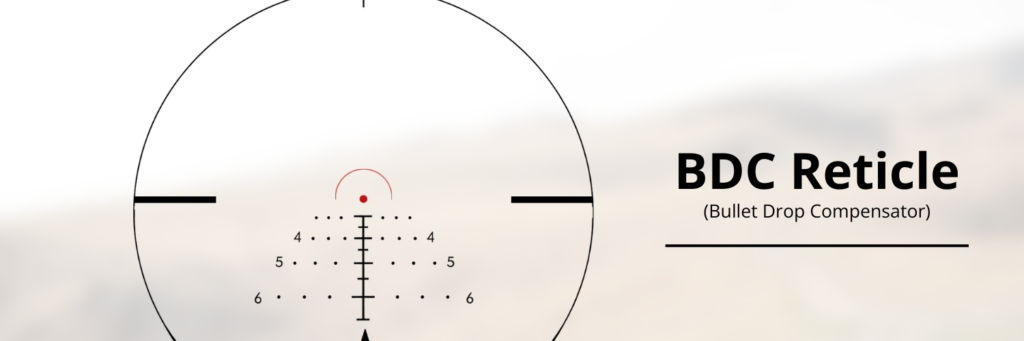
The primary strength of a BDC reticle is how easy it is to use. Instead of learning a measurement system, the shooter only needs to remember which mark corresponds to which distance. This reduces mental load and allows for quick and easy decision-making in the field.
That simplicity translates directly into speed. For typical hunting or carbine distances, a BDC reticle allows you to move from target identification to shot execution with minimal delay. There’s no need to reference data or calculate holds—just select the appropriate mark and shoot.
Another benefit is the simplicity of the sight picture. Most BDC reticles are relatively clean, which helps keep your focus on the target rather than the reticle itself. In an LPVO, this contributes to a more intuitive shooting experience, especially for those who prioritize simplicity and consistency over maximum precision.
For shooters running a single rifle with consistent ammunition and operating within a predictable range of distances, a BDC reticle offers a low-maintenance and efficient solution.
The simplicity of a BDC reticle comes with limitations.
Every BDC is built around a specific set of assumptions, including caliber, bullet weight, velocity, and environmental/weather conditions. When your real-world setup deviates from those assumptions, the reticle measurements become less accurate.
Additionally, BDC reticles typically stop being effective around 600 yards/meters as you lose muzzle velocity.
Wind also presents a challenge. Many BDC reticles lack a structured system for wind holds, leaving the shooter to rely on estimation rather than precise, repeatable corrections. If wind holds are present, they’ll similarly lose accuracy as ballistics and environmental conditions vary or distance increases.
These limitations may not seem to matter at shorter distances or on larger targets, but they become significantly more noticeable as you stretch range or demand tighter accuracy. In those situations, a BDC reticle often delivers approximate solutions rather than exact ones, which can reduce hit probability and accuracy.
An MRAD grid reticle is based on milliradians, an angular unit used to help measure both elevation and wind adjustments.
Instead of preset distance marks, the reticle features an evenly spaced grid or series of hash marks spaced in 0.1 mil increments along the vertical and horizontal stadia.
Unlike a BDC, an MRAD grid reticle is not limited to any specific cartridge or atmospheric conditions. It functions as a universal reticle for any set of ballistics and any weather conditions.
The shooter pairs the reticle with ballistic data through a ballistics app or solver that provides precise elevation and wind values in mils for a given distance and condition.
This shifts the process from approximation to true precision. Rather than asking which preset mark is closest, the shooter applies the exact hold required. In an LPVO, this creates a system that – with just a little more prep – remains fast and easy up close while also remaining highly precise as magnification increases and distance increases.
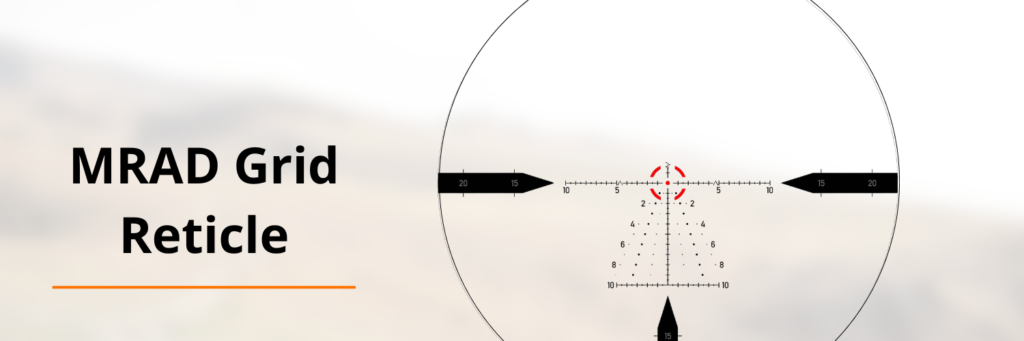
You’ll hear people sometimes say that MRAD grid reticles are hard to use, cluttered and too busy to used effectively.
However, MRAD grid reticles actually excel in precision and adaptability, where others often fall short. Because they rely on real ballistic data and real-time local atmospherics rather than preset assumptions, they allow for more precise holds regardless of ballistics or atmospherics.
Wind is also handled more effectively. The horizontal mil scale or Time-of-Flight wind dots (in many cases) in the reticle provide a way to more precisely hold for wind.
Additionally, an MRAD grid reticle works regardless of the rifle, ammunition, or environment. If something changes, you simply update your data while the reticle itself always remains valid and calibrated. This allows for engaging targets at greater distances while maintaining a high level of accuracy.
This makes it particularly valuable for shooters who operate across varying conditions, are using different rifles or want a system that can grow with their skill level.
After getting over the initial learning curve, this adaptability leads to more consistent performance, allowing marksmen to operate at a higher level of precision.
The main drawback of an MRAD grid reticle is the learning curve. To use it effectively, the shooter must understand mils and be willing to work with ballistic data. This means using a ballistic solver or app to confirm your atmospherics, ballistic coefficient, muzzle velocity and more.
The reticle can also appear more complex, especially to new shooters. The additional markings and grid structure provide a lot more data to the shooter compared to the simplicity of a BDC.
However, this complexity tends to diminish with experience. As shooters become more familiar with their data and holds, the reticle becomes easier to read and faster to use. What can initially feel like a drawback often becomes a strength, providing greater control and confidence as experience increases.
| Aspect | BDC Reticle | MRAD Grid Reticle |
1. Core Concept | Distance-based holdovers tied to specific, fixed ballistics & atmospherics | Angular measurement system with evenly spaced mil markers |
| 2. Close-Range Use | Fast and intuitive | Equally fast |
| 3. Precision | Approximate; dependent on matching conditions | High precision with exact holds for any set up |
| 4. Wind Holds | Limited or unstructured | Built-in and precise |
| 5. Flexibility | Limited to specific setup | Highly adaptable |
| 6. Learning Curve | Minimal | Moderate but scalable |
| 7. Distance | <600 yards | 800+ yards (Limited by scope magnification and rifle accuracy) |
A good example of a grid reticle is the TREMOR7™ reticle in the Horus HoVR® 1–8x24mm LPVO Riflescope. At 1x, the illuminated center provides a quick and intuitive aiming point, allowing for fast engagement with both eyes open.
As distance increases, the shooter can dial up magnification and apply precise holds based on ballistic data. For example, if a target requires 2.4 mils of elevation, that value can be held directly in the reticle without approximation.
This approach removes any uncertainty. Instead of relying on generalized holdovers, the shooter is applying exact, real-time data. This LPVO is a great option for shooters that need to perform across a range of distances, and can significantly improve consistency and confidence when behind the glass.
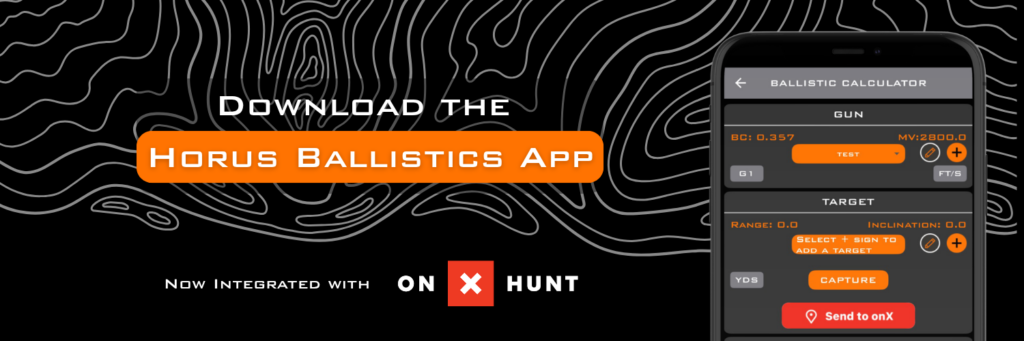
One of the most effective ways to simplify MRAD use is through a ballistic app. The FREE Horus Ballistics App is designed to work seamlessly with grid reticles, generating elevation and wind solutions in mils or MOA built around your rifle, ammunition, and local environment.
This removes the need for manual calculations and makes it easier to adapt to changing conditions and ballistics. Whether you switch loads or move to a new location, you can quickly update your data and maintain a high level accuracy, knowing that the Horus Ballistics app was derived from a military-validated solver.
By aligning your reticle with reliable ballistic information, the system becomes easier to use and understand over time. Instead of guessing on a shot, you’re working from confirmed data, which leads to more consistent results in real-world shooting situations.
Plus, be sure to check out the latest features of the Horus Ballistics App, which includes onX Hunt Waypoint functionality. Send data points directly from the app to onX Hunt to seamlessly pin targets or locations in the field.
Choosing between a BDC and an MRAD grid reticle ultimately comes down to how you shoot and what you expect from your system.
Choose BDC Reticle: If you value simplicity, run a consistent setup, and operate within predictable distances and don’t require a high level of precision. It offers a fast and effective solution with minimal learning required.
Choose MRAD Grid Reticle: If you shoot in changing conditions, at varied distances, extended ranges, swap between rifles, or have a need for greater precision. This reticle is better when building a more capable and adaptable system.
In other words, BDC reticles prioritize ease of use, while MRAD grid reticles prioritize flexibility and accuracy. The best choice is the one that aligns with your needs, your environment, and how you want to grow as a precision shooter.
To learn more about MRAD grid reticles, click here.
Horus Vision is the industry authority in reticle design and ballistic technologies. Known for creating the original grid-based reticle, Horus Vision revolutionized long-range shooting by enabling marksmen to visually correct for bullet drop and windage instantly. Today, Horus technologies are used by elite military units, competitive shooters, and precision rifle enthusiasts around the world.
